How does it look from here?
Monitor suitable public-facing devices and services from the Pulse platform. See their availability and response from an external monitoring point.
 MAKE IT POSSIBLE. MAKE IT DEPENDABLE. MAKE IT BETTER.
PULSE / NETWORK EXPERIENCE MONITORING
Your people are struggling to get online or use a service. Your monitoring looks healthy. Your provider can't see a problem. Where do you start?
And somewhere in the middle of all that, somebody has to work out what's actually happening.
We know that feeling rather well. It's one of the reasons we built Pulse.
THE QUESTION THAT STARTED IT
Something isn't adding up.
“The network's been terrible all morning.”
By the time that message reaches whoever looks after the technology, everyone has a different account. The people using it know it's painful. The provider's tests look healthy. The network equipment seems quite content with itself.
And yet the problem is real to the person staring at a screen that won't load.
We've spent enough time thinking about infrastructure to know that another dashboard doesn't automatically make that conversation any easier. What you need is a way to see the experience, not just the status.
So we kept coming back to a more useful question: what could we actually prove about what happened?
A DIFFERENT STARTING POINT
Both things can be true. One check tells you that something answered. It doesn't tell you how well it worked for somebody somewhere else, or what happened ten minutes earlier.
Pulse gives you a clearer record of what was reachable, what was slow and when things changed. You can see the history instead of trying to piece it together after the problem has passed.
LOOK FROM THE RIGHT PLACE
One office might be working normally while another cannot reach the services it needs. Pulse can check from outside your network and from a monitoring agent inside it, helping you see where the experience differs.
Monitor suitable public-facing devices and services from the Pulse platform. See their availability and response from an external monitoring point.
Use our lightweight, installable agent to monitor authorised internal devices and services from within your own environment.
Pulse records where each check was made. That helps you understand what the result really tells you.
THE PART WE CARE ABOUT MOST
The ones you only really notice when a monitoring system gets them wrong.
There are easier things to build than a system that respects uncertainty. But we'd rather tell you what the evidence means than make a wrong answer look convincing.
Pulse uses confirmed monitoring state and a recorded history, so a single observation doesn't have to become a dramatic conclusion.
If a monitoring agent stops reporting, Pulse shows that you've lost visibility from that location. It doesn't automatically claim that every device it checked has failed.
Latency, packet loss, trends and comparisons help you see deterioration that a simple online or offline label might miss.
FROM FRUSTRATION TO EVIDENCE
Picture the next time somebody tells you everything has been slow all morning. Instead of trading opinions, you have a history to follow.
See which monitored devices and services need attention, and when their behaviour changed.
Explore Events, recorded network paths, trends and observations from the relevant monitoring location.
Share the evidence with the technical teams, colleagues or providers best placed to investigate and put things right.
Not an argument about whose dashboard is right. A more useful conversation about what the evidence shows.
THE TOOLS BEHIND THE STORY
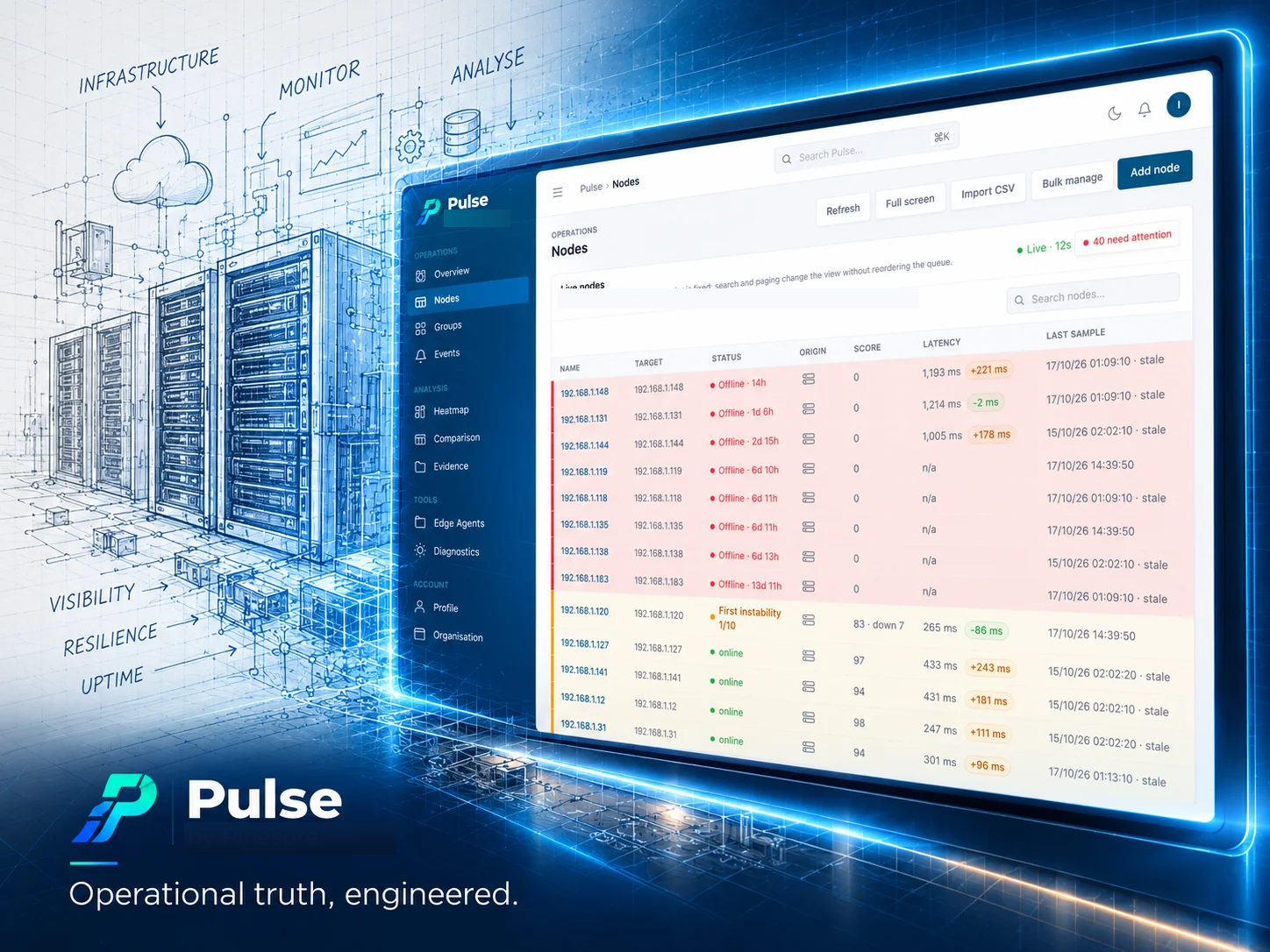
Pulse brings day-to-day monitoring and deeper investigation into the same place, so you can begin with what matters and follow the detail.
THE CURRENT PICTURE
See what's healthy, what's changed and what deserves attention.
A RECORD TO REVISIT
Follow an issue through time and take the relevant facts into the next conversation.
THE WIDER PATTERN
Find changes across relevant devices, services and periods of time.
BUILT FOR THE PEOPLE DOING THE WORK
You decide what matters in your environment. Pulse gives you monitoring, alerts, investigation tools and evidence you can use, whether you're an IT manager, an infrastructure specialist or a service provider looking after customers.
We're responsible for building and operating the platform. You're in control of your monitoring and response.
A PRACTICAL FIRST STEP
A FEW QUESTIONS WORTH ASKING
Yes. Our lightweight, installable agent monitors selected authorised devices and services from within your own environment. The platform also gives you an external perspective on suitable public-facing targets.
Pulse records availability, latency, packet loss and relevant Events over time. Review trends, comparisons and network-path observations to understand when and where the change was observed.
Yes. Use the recorded evidence to show when the issue occurred, which monitored devices and services were affected and how their behaviour changed. Give the people investigating or restoring service a clearer starting point.
THE NEXT TIME IT HAPPENS
We built Pulse because a reassuring status light isn't much comfort when people are struggling to get their work done.
See where a problem was observed, when things changed and which monitored devices and services were affected. Give the right people a history they can work with.
Less time trying to prove there's a problem. More time understanding what to do next.